The Gap Between What AI Says and What It Knows
There is a moment in every conversation with a large language model when something strange happens. The response arrives instantly, shaped into clean paragraphs, threaded with confident assertions, and delivered with the steady assurance of a well-briefed expert. It reads like truth. It sounds like truth. And yet, somewhere beneath that polished surface, there may be no truth at all just language doing what language has always done: expressing ideas that feel precise while remaining logically incomplete.
This is the honesty gap. Coined in a GenXis Research analysis by Daryl Ledyard and Philip Tyler, D.M., the term describes the distance between persuasive language and verified truth. The concept matters for everyone who uses AI systems, from students drafting essays to doctors reviewing clinical summaries, because the danger doesn't come from obvious errors. It comes from the mismatch between linguistic confidence and verified grounding.
The anxiety around artificial intelligence, Ledyard and Tyler write, is not merely that machines can be wrong. It is that machines can be wrong in fluent, reasonable, socially persuasive language. Words can escape meaning. They can rationalize, soften, blur, excuse, reframe, and drift. In human psychology this is visible in motivated reasoning, cognitive dissonance reduction, moral disengagement, euphemistic labeling, and ethical fading. In AI systems it appears as hallucination, unsupported synthesis, and citation-shaped language without source custody.
Why Words Are Squishy
Understanding the honesty gap requires understanding why language alone is a weak carrier of machine-grade certainty. Natural language is flexible by design. It allows approximation, metaphor, implication, emphasis, ambiguity, and context dependence. Those features make language humanly useful, but they also make it a dangerous vehicle when certainty is required.
A sentence can feel precise while remaining logically incomplete. Consider phrases like "this was handled responsibly," "the model is aligned," "the evidence supports the claim," or "the outcome was acceptable under the circumstances." Each may be true, false, evasive, or meaningless depending on hidden definitions. What counts as responsible? Which model? What evidence? Which circumstances?
Informally, people now use words such as vibes and slop to describe language that feels meaningful while carrying weak constraint. This informal vocabulary captures something important: the difference between language that points toward reality and language that merely mimics the texture of pointing.
The problem is not new. It has simply migrated into new territory. The education sector has spent years wrestling with a parallel phenomenon a documented honesty gap between how states report student performance and what standardized national assessments reveal about actual learning.
The Education Parallel: A Honesty Gap Everyone Can See
In April 2026, the U.S. Chamber of Commerce Foundation published an analysis of America's Academic Outcome Truth Serum, produced in partnership with the Collaborative for Student Success. The report quantified the gap between state-reported proficiency rates and performance on the National Assessment of Educational Progress (NAEP), also known as the Nation's Report Card.
The findings were striking. In Iowa, the 2024 state-reported eighth-grade math proficiency rate stood at 72%, while NAEP reported only a 27% proficiency rate a 45-percentage point difference. Virginia showed a 73% state-reported fourth-grade reading proficiency rate against a 31% NAEP rate, a 42-point gap. Michigan's eighth-grade reading showed a 65% state rate versus a 24% NAEP rate. New York reported over 50% of fourth graders as proficient in math on its state test, while less than 40% cleared the same bar on NAEP.
These aren't minor discrepancies. They represent millions of students whose families believe they are on track for college and career readiness when national benchmarks suggest otherwise.
Cory Koedel, a tenured professor of economics and public policy at the University of Missouri-Columbia who has spent more than twenty years studying school performance, wrote in April 2025 that the education system often fails to communicate honestly with students, parents, and community members about how much students are actually learning. The discrepancy between actual student performance and what is reported is the honesty gap.
Koedel pointed to a troubling example: the gap between students' grades and their performance on standardized tests, which has grown tremendously since the pandemic. Grades are up, but test scores are down. This disconnect matters because grades tend to carry more weight with students and parents than test scores. Many parents assume that the grades their children receive are accurate indicators of academic progress. But this assumption is increasingly incorrect. Grades have become more and more disconnected from actual achievement.
This may help explain why 90% of parents believe their children are performing at or above grade level in reading and math, even though only about one third of fourth- and eighth-grade students in the United States score at a proficient level on NAEP. The gap between perception and reality isn't a failure of parenting it's a structural feature of how information moves through systems that have incentives to be encouraging rather than accurate.
How the Honesty Gap Compounds Over Time
Dale Chu, writing for the Thomas B. Fordham Institute in February 2025, noted that as states continue lowering proficiency thresholds, the disconnect between what students are learning and how their progress is reported grows wider. Compounding the problem is rampant grade inflation, which only got worse during the pandemic and has since widened both performance and attendance gaps.
These inconsistencies aren't new. More than fifteen years ago, colleagues Checker Finn and Mike Petrilli warned of these dangers in their introduction to The Proficiency Illusion, which lamented even then the vast discrepancies in how states defined proficiency: "America is awash in achievement 'data,' yet the truth about our educational performance is far from transparent and trustworthy. It may be smoke and mirrors. Gains (and slippages) may be illusory. Comparisons may be misleading. Apparent problems may be nonexistent or, at least, misstated."
The Common Core and its associated exams significantly narrowed these differences, but now they're opening up again. As these gaps widen, so too does the disconnect between perception and reality stymieing progress and making it harder to ensure students are truly prepared.
The pattern is consistent: when standards are lowered, the distance between reported outcomes and verified outcomes grows. Over time, small verbal deviations compound like a singer drifting slightly off pitch until the tonal center is lost. The problem isn't that anyone sets out to deceive. The problem is that the system allows language to drift toward what is encouraging rather than what is accurate.
From Education to AI: The Same Mechanism, New Stakes
In AI systems, the stakes are different but the mechanism is the same. Large language models are trained on vast corpora of human-generated text, and they learn to produce language that patterns well with that training data. The result is prose that sounds authoritative, structured, and confident language that has the texture of truth without necessarily carrying the weight of verification.
A legal citation can be fabricated in perfect legal prose. A medical explanation can sound clinically plausible while omitting a contraindication. A financial summary can appear authoritative while relying on stale facts. In each case, the danger comes from the mismatch between linguistic confidence and verified grounding.
The central question, Ledyard and Tyler write, is: when does a sentence become a verified claim? They define a claim not as merely a sentence, but as a tuple where p is the statement, d is the domain, t is the truth condition, and e is the evidence requirement. Without those elements, language remains expressive but under-bounded. It may point toward a reality without specifying the procedure by which that reality is checked.
This definition matters for AI developers, AI users, and anyone who relies on AI-generated content in high-consequence domains. It provides a framework for asking: what would it take for this sentence to be a verified claim rather than just fluent language?
What Developers Can Do: Anchoring Language to Math
The antidote, according to the GenXis Research analysis, is not less language, but stronger grounding. Specifically, the paper identifies several mechanisms that can close the honesty gap:
- Mathematical constraint Using formal verification methods and structured logic to bound what language can express
- Source custody Maintaining traceability between generated content and its origins
- Deterministic checks Applying rule-based verification that produces consistent results
- Calibrated abstention Training systems to decline to answer when confidence is insufficient
- Evidence memory Building systems that remember what evidence supports what claims
These aren't abstract ideals. They represent concrete engineering choices that developers can make when designing AI systems. A model that is trained to say "I don't know" when its confidence is low is practicing calibrated abstention. A system that cites its sources with links back to verifiable documents is practicing source custody. A model that runs generated claims through a formal verification layer before presenting them is practicing deterministic checks.
The education sector offers a template for what happens when these mechanisms are absent. States that lowered proficiency thresholds to appear more encouraging created a structural honesty gap. The remedy, as Ohio demonstrated, involves raising standards to align with national benchmarks and committing to transparency over comfort.
When Ohio replaced its Achievement Assessments with PARCC in 2014-15, proficiency rates dropped not because students suddenly learned less, but because the measurement standard changed. The result was a narrower honesty gap and a clearer picture for parents and citizens about where students stand relative to rigorous academic goals.
States That Closed the Gap: A Case Study in Progress
The most recent Honesty Gap analysis, released by the Collaborative for Student Success, shows that progress is possible. Only two states eliminated their honesty gap entirely in the 2023-2024 school year. But Massachusetts and Rhode Island closed their gaps to within 5 percentage points or less across both grades and subjects. In addition, fourteen states are holding students to an equal or higher standard than NAEP in at least one grade or subject.
Virginia stands out as a state that has committed very publicly and explicitly to addressing the problem. The state redesigned its school accountability and accreditation system, committed significant funding to high-dosage tutoring and literacy initiatives, and made transparency a stated priority rather than an afterthought.
The trend line is directionally positive. In 2014, 23 states had the "biggest honesty gaps" in fourth-grade reading defined as 30 percentage points or larger. In 2024, only Alabama, Iowa, Nebraska, and Virginia have gaps that large in fourth-grade reading. In 2014, 14 states had the biggest honesty gaps in eighth-grade math. In 2024, only Iowa, Mississippi, and Virginia have gaps that large.
"To be clear, improving student outcomes takes huge commitments from states on efforts like high quality curriculum, strong teacher development and student supports," said Jim Cowen. "But the truth matters. We salute the states that are embracing the issue rather than masking it or running away from it."
Why This Matters for GenXis Research Readers
If you are building with AI, deploying AI, or making decisions based on AI-generated content, the honesty gap is not an academic concern it is a practical risk. A marketing team that relies on AI-generated claims without verification may publish statements that are misleading. A product team that uses AI to summarize user research may draw conclusions that aren't supported by the underlying data. A researcher who uses AI to draft literature reviews may miss crucial sources or mischaracterize findings.
The GenXis Research analysis offers a framework for thinking about this risk: ask whether the language in question is expressive but under-bounded, or whether it has crossed into verified claim territory. Does the statement have a clear domain? A specified truth condition? An evidence requirement? If not, treat it as language, not truth and verify before acting.
A Guide to the Current Honesty Gap Landscape
To understand the scale of the education honesty gap, consider these state-by-state comparisons from the 2023-2024 school year, as documented by the U.S. Chamber of Commerce Foundation analysis:
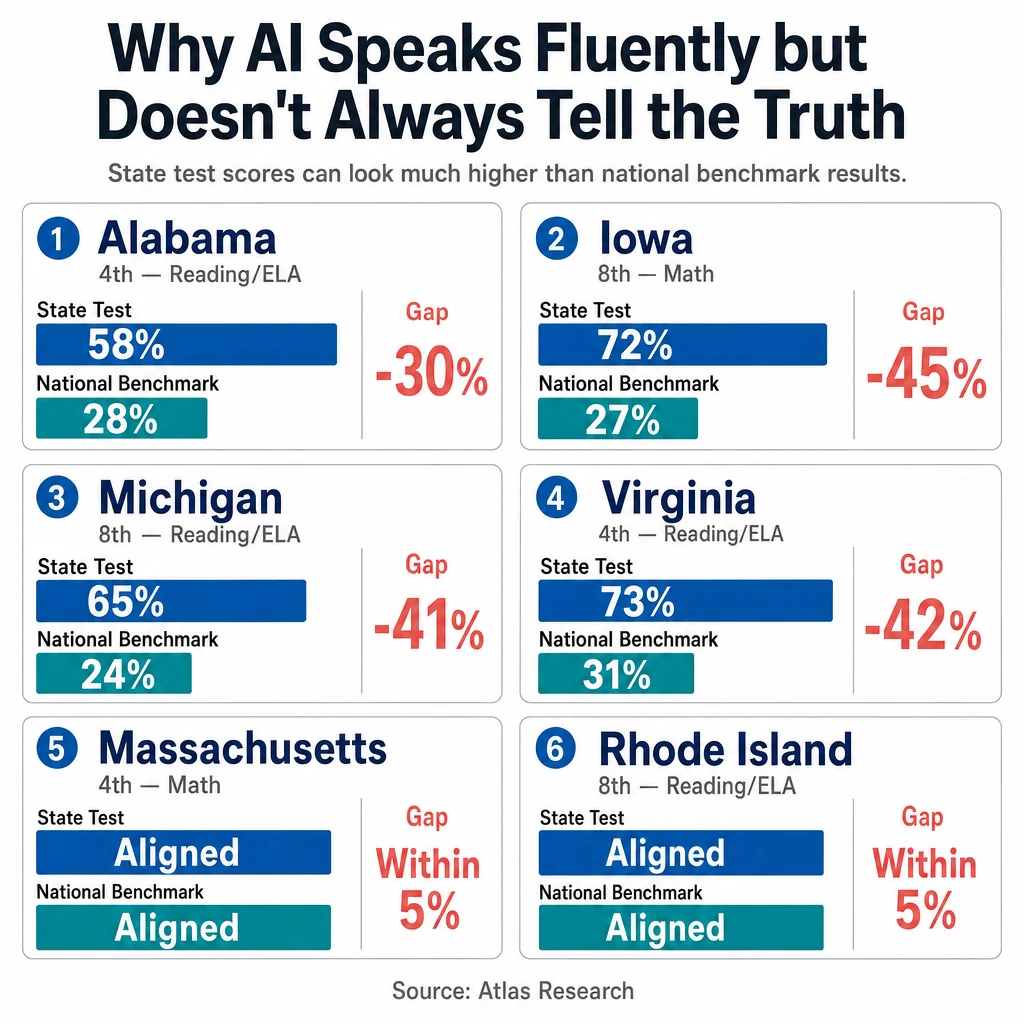
| State | Grade | Subject | State Test Proficiency | NAEP Proficiency | Gap |
|---|---|---|---|---|---|
| Alabama | 4th | Reading/ELA | 58% | 28% | -30% |
| Iowa | 8th | Math | 72% | 27% | -45% |
| Michigan | 8th | Reading/ELA | 65% | 24% | -41% |
| Virginia | 4th | Reading/ELA | 73% | 31% | -42% |
| Massachusetts | 4th | Math | Aligned | Aligned | Within 5% |
| Rhode Island | 8th | Reading/ELA | Aligned | Aligned | Within 5% |
These numbers illustrate what happens when standards are lowered: the gap between reported outcomes and verified outcomes grows. The same mechanism operates in AI systems, where models trained on human-generated text learn to produce language that patterns well with confident assertions even when those assertions are unverified.
The Practical Path Forward
Koedel's conclusion from the education sector applies equally to AI: "We should demand high standards from our educational institutions, even if the truth hurts." The cognitive skills students learn in school really matter for later-life success, and glossing over declining test scores our best measures of these skills will not change this fundamental fact.
For AI systems, the equivalent principle is straightforward: demand verification before deployment in high-stakes domains. A model that generates a first draft is useful. A model that generates a first draft with source citations and confidence indicators is more useful still. A model that declines to answer when it cannot verify its claims is the most useful of all, because it respects the boundary between fluent language and verified truth.
The honesty gap is not a flaw that can be patched out of existence. It is a structural feature of language itself a feature that humans have always navigated, and that AI systems must now learn to navigate as well. The question is not whether we can eliminate the gap. The question is whether we can build systems that help users see it clearly and act accordingly.
Where to Read Further
For a rigorous philosophical and technical framework for thinking about the honesty gap in AI systems, the GenXis Research paper "The Honesty Gap: Words Vs. Math" by Daryl Ledyard and Philip Tyler, D.M., provides the foundational definition and explores the mechanisms through which language drifts and how verification anchors can help.
For context on how the honesty gap manifests in education a domain where the phenomenon has been measured, quantified, and studied for over a decade the U.S. Chamber of Commerce Foundation's April 2026 analysis of America's Academic Outcome Truth Serum offers state-by-state data and policy implications.
For a practitioner's perspective on how the education sector is addressing the honesty gap, the Fordham Institute's commentary "Mind the honesty gap" by Dale Chu examines the accountability failure and the path forward through transparency and rigor.