


Most marketers are doing Answer Engine Optimization wrong. Not because they lack effort or intelligence, but because they've been handed a map drawn for the wrong territory.
The conventional wisdom goes something like this: if your content ranks well on Google, AI engines will naturally cite you. After all, doesn't Google's algorithm already identify quality sources? And aren't these AI systems just synthesizing web content anyway? So the playbook becomes simple: keep doing SEO, maybe add some schema markup, and you'll appear in ChatGPT answers eventually.
This thinking is comfortable. It's also demonstrably false and the data from 2026 makes that harder to ignore every month that passes.
The Map Was Drawn for a Different Country
Christian Lehman at AuthorityTech spent a month digging into peer-reviewed research on citation mechanics across ChatGPT, Perplexity, and Google AI Overviews. The findings, published in May 2026, upend several pieces of conventional GEO wisdom that marketers have been treating as settled truth.
"The biggest misconception in GEO right now: if you rank on Google, AI engines will cite you," Lehman writes. "The data says otherwise." His analysis drew from a 2026 study across 602 prompts and 21,143 citations to measure citation behavior across three platforms.
The numbers are stark. According to data cited from BrightEdge in 2025, 57.1% of AI Overview sources come from outside the Google top 10. In Google's newer AI Mode, that number climbs to 88% meaning nearly 9 out of 10 cited pages are invisible to traditional rank trackers.
Think about what that means for your SEO dashboard. You could hold the number-one position for your most valuable keyword, generating steady Google traffic, and still never appear in a single AI citation for that topic. Meanwhile, a page sitting in position 47 invisible to your analytics, ignored by your rank-tracking tool becomes the source that shapes what AI tells your potential customers about you.
This isn't a minor edge case. It's a structural disconnect between the optimization surface most marketers live on and the surface where AI citation decisions actually get made.
Why This Gap Exists: The Two-Pathway Problem
To understand why traditional SEO rankings predict AI citations so poorly, you need to understand something about how answer engines actually work and the machinery has two distinct modes that most AEO advice conflates or ignores entirely.
Lehman breaks this down clearly: "AI answer engines use two mechanically distinct pathways training-corpus recall (6-12 month update cycle) and live RAG retrieval (24-72 hours) and most brands optimize for one without knowing which governs their citations."
Training-corpus recall means your content was ingested during the AI model's training phase. When ChatGPT or Claude answers a question, they're drawing partly on this absorbed knowledge content that was incorporated into the model's weights during its last training run. This pathway has a 6-to-12-month lag. No matter how brilliant your content is today, it won't enter this pathway until the next training cycle completes.
Live RAG retrieval retrieval-augmented generation is the faster pathway. When you ask Perplexity a question, it typically searches the web in real-time, pulling content that exists right now. This pathway can surface your content within 24 to 72 hours of publishing, if the retrieval system can find and extract it effectively.
Most AEO advice ignores this distinction entirely. A checklist that tells you to "add schema markup" and "write FAQ content" might help with one pathway while doing nothing for the other. And since different engines weight these pathways differently, your optimization strategy needs to be platform-specific, not a one-size-fits-all checklist.
John Paul Mains at Click Laboratory frames this as a pipeline problem. "If you only optimize for 'get cited' tips, you end up polishing pages that the retrieval step never pulls in," he explains. "If you only chase rankings, you can win Google and still sit outside the passages an answer engine wants to quote."
The Citation Frequency Illusion
Here's where things get counterintuitive for marketers who think more citations always means more visibility.
Lehman's study measured what he calls the "absorption gap" the difference between how many sources an engine cites and how much content it actually extracts from each one. The data reveals a striking inverse relationship:
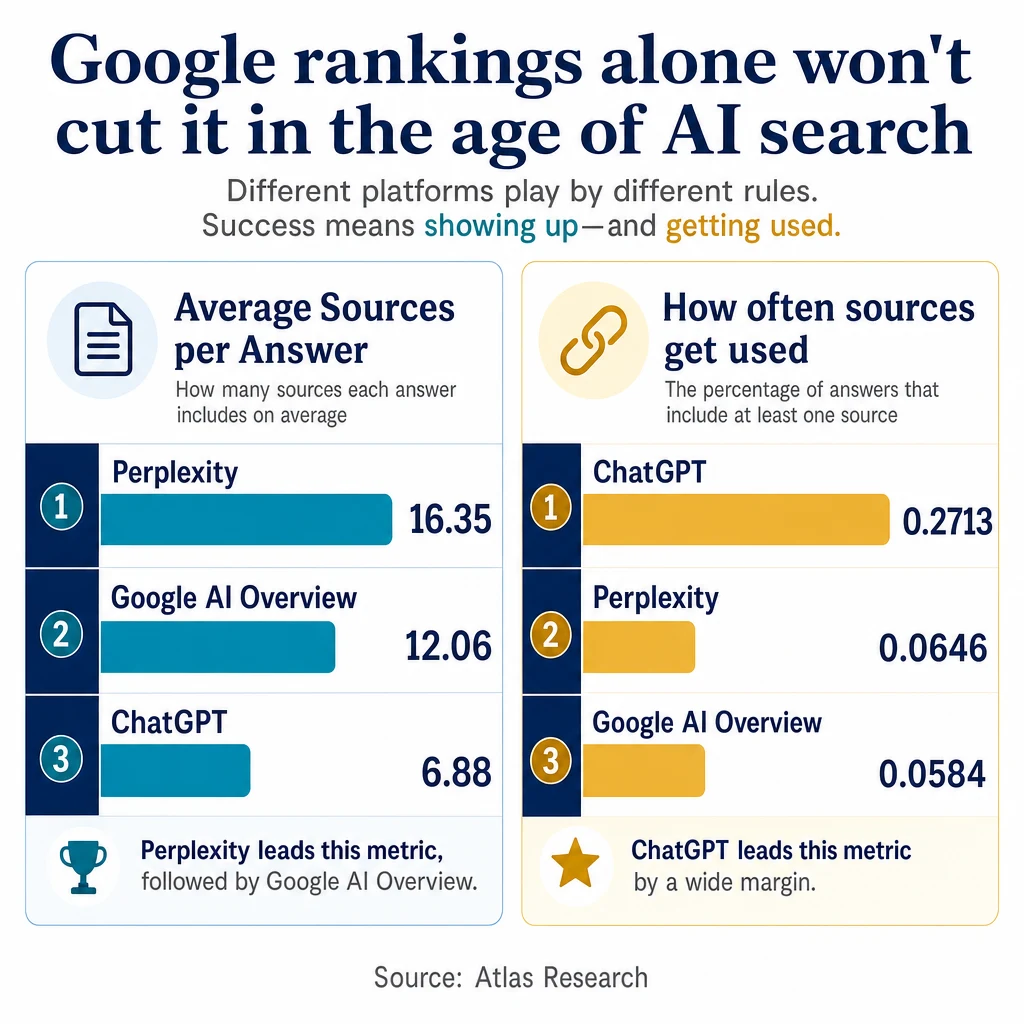
| Platform | Mean Citations per Answer | Citation Absorption Rate |
|---|---|---|
| Perplexity | 16.35 | 0.0646 |
| Google AI Overview | 12.06 | 0.0584 |
| ChatGPT | 6.88 | 0.2713 |
Perplexity casts the widest net citing roughly 16 sources per answer but each citation contributes almost nothing to the final response. ChatGPT cites roughly 7 sources but extracts 4.2x more language and evidence from each one.
This has immediate tactical implications. If you're optimizing for Perplexity, volume and breadth matter. You want your brand mentioned across many sources, in many contexts, so you enter that wide net. If you're optimizing for ChatGPT, depth and extractability per page is what counts. One deeply authoritative page that AI can fully absorb will outperform ten surface-level mentions.
Most AEO advice ignores this distinction. A strategy that works for one platform may actively underperform on another.
What Actually Gets Cited: Structure Over Authority
So if traditional rankings don't predict citations, and raw volume doesn't guarantee absorption, what does determine whether your content gets pulled into AI answers?
The data points consistently to structure specifically, the structural features that make a page extractable by a retrieval pipeline.
A Writesonic analysis of over 1 million AI Overview citations found that pages with clean heading hierarchy and schema markup earn 2.8x higher citation rates. The same analysis found that 73% of ChatGPT-cited pages include at least one bulleted list section. Pages using three or more relevant schema types show roughly 13% higher citation likelihood.
But the most striking finding comes from an arxiv study that compared top-quartile versus bottom-quartile cited pages. The structural differences are dramatic:
- Word count is 11.4x higher in the most-cited pages
- Heading count is 12.5x higher
- List density is 8.9x higher
More content, more headings, more lists. Not the minimalist, scannable content that UX consultants have been recommending for a decade.
This creates a real tension. Traditional SEO wisdom says shorter, punchier content wins. A/B tests show users skim rather than read. Navigation should be frictionless. Every word must earn its place.
But AI retrieval systems aren't human readers. They're pipelines that need signals clear topic boundaries, extractable passages, verifiable claims, and enough depth for the model to trust the source. A 300-word blog post with a clean UX might delight a human reader and completely fail the retrieval step.
The Q&A Trap
Here's where the counterintuitive finding bites hardest. One of the most widely circulated pieces of AEO advice is to structure content as questions and answers FAQ sections, "What is X?" headings, direct Q&A formatting. The logic seems sound: if AI wants direct answers, give it direct answers in question-and-answer form.
Lehman flags the problem: "Q&A format actually hurts absorption by 5.74%, despite being widely recommended."
This matters because FAQ schema has been one of the most frequently cited AEO tactics. Marketers implementing it may be optimizing for the wrong signal getting the markup right while actively reducing their content's absorbability.
The alternative isn't mystery. Content types that boost absorption include comprehensive guides, original research reports, and expert interviews the kind of content that provides depth, context, and original evidence rather than compressed answers to common questions.
Brand Mentions: The New Backlinks
If there's one finding that most dramatically reshapes the AEO playbook, it's this: branded web mentions correlate with AI visibility more strongly than traditional backlinks.
The LoudScale team analyzed 680 million citations to understand what signals actually move the needle. Their data shows branded web mentions have a 0.664 correlation with AI Overview visibility, while backlinks sit at 0.218. That's a 3x difference in predictive power.
For marketers who spent the last decade building link-building programs, this is a uncomfortable pivot. The strategy that drove SEO success earning links from high-authority domains matters less for AI discovery than a different kind of authority signal: being mentioned across the web in contexts that AI systems can recognize and verify.
Justin Borges, founder of The Answer Engine, frames this as a fundamental shift in what authority means. "Unlike paid advertising that stops generating leads the moment you stop paying, answer engine presence compounds," he writes. "Once AI systems recognize your content as authoritative, they continue citing you without additional spend."
This has implications for where you should be investing your PR and content efforts. Press mentions, podcast appearances, LinkedIn posts, YouTube videos, and industry citations may now be as important for AI discovery as the backlinks you've been chasing and in some cases more important.
The Four Pillars of Citation Eligibility
So what does it actually take to become citable? The sources agree on a framework that's more demanding than most AEO checklists suggest and more demanding than the traditional SEO playbook it overlaps with.
According to Triaza's May 2026 guide to AI search, citation visibility comes down to four things:
- Crawlable and indexable the engine's bot can reach and render your content
- Direct answer to the question structured so it's easy to extract a clear response
- Backed by real expertise original evidence rather than recycled summary
- Corroborated across the web earned media, LinkedIn, YouTube, and other trustworthy references that repeat your claims
Do all four and you're eligible across every major engine. Miss one and you tend to get summarized without the link your content gets absorbed into the AI's response while the citation goes to someone else.
Kim Reynolds puts it directly: "Getting cited by answer engines comes down to one thing: writing content that AI systems can extract, verify, and repeat with confidence." The key word is verify. AI systems aren't just looking for answers they're looking for sources they can trust enough to quote. And trust, in this context, means signals that cross-reference each other across the web.
This is why Borges emphasizes the compounding nature of answer engine presence. "The businesses that optimize first will be the ones AI platforms trust and recommend," he writes. "Waiting 6 months means your competitors have a 6-month head start."
What This Means for Optimizing for Answer Engine Citations Readers
If you're publishing content to attract AI citations, the implications are concrete. First, stop treating your Google ranking dashboard as a proxy for AI visibility. The correlation is weaker than conventional wisdom suggests and getting weaker as AI systems build their own citation preferences independent of Google's ranking signals.
Second, invest in depth. The most-cited pages in AI systems are 11x longer than average not because AI prefers long content, but because depth signals trust. Comprehensive coverage of a topic gives retrieval systems more extractable passages and more opportunities to cite you.
Third, build brand mentions as deliberately as you build backlinks. Your PR strategy, your podcast appearances, your LinkedIn activity, and your YouTube presence are now part of your AEO infrastructure. The corroboration signal having your claims repeated across trustworthy sources may matter as much as any on-page optimization.
Fourth, tailor your strategy to your target platform. Optimizing for ChatGPT means building deep, authoritative pages that extract well. Optimizing for Perplexity means building breadth and volume across many mentions. These aren't the same strategy.
The Window Logic
Borges uses language that will feel familiar to anyone who remembers the early days of SEO: urgency. "Every industry has a limited number of AI citation slots," he writes. "The businesses that optimize first will be the ones AI platforms trust and recommend."
This framing is contested. Critics might say it's vendor hype a way to pressure prospects into immediate action. But there's structural logic behind it that the data supports. AI systems do develop citation habits, and those habits are sticky. A brand that becomes the trusted citation for a category query is hard to displace not because the algorithm is biased, but because the AI has learned to trust that source.
Early movers in any category have a compounding advantage. Each citation reinforces the source's credibility in the next retrieval. Each appearance builds corroboration signals across the web. The longer you wait, the more established your competitors' citation presence becomes.
Google's own May 2026 guide to generative AI search says AI Overviews and AI Mode are rooted in core Search ranking and quality systems, use retrieval-augmented generation and query fan-out, and do not require llms.txt, special AI markup, or special schema. This is worth noting: Google's official guidance downplays many of the technical tactics that vendors recommend. What Google says matters most is quality but the data from multiple sources suggests that quality alone isn't enough if your content structure doesn't support extraction.
Where to Read Further
The sources in this article represent some of the most thorough public analysis of AEO citation mechanics available as of mid-2026. For deeper dives into specific aspects of answer engine optimization:
- Christian Lehman's analysis at AuthorityTech the platform-specific absorption data and the 602-prompt study
- LoudScale's analysis of 680 million citations brand mention correlation data and the AEO priority matrix
- Click Laboratory's five-stage pipeline breakdown practical framework for understanding retrieval upstream of citation
- Triaza's startup-oriented guide Google's May 2026 guidance and the four-pillar citation framework
- Kim Reynolds' 2026 guide the SEO vs. AEO comparison table and schema markup deep dive
- The Answer Engine's complete guide Justin Borges on compounding authority and market timing
FAQ: Common Questions About Answer Engine Optimization
What is Answer Engine Optimization (AEO)?
Answer Engine Optimization is the practice of structuring content so AI-powered systems like ChatGPT, Perplexity, and Google AI Overviews cite your brand as a source not just rank it in traditional search results. Unlike SEO, which optimizes for click-through from a ranked list, AEO optimizes for inclusion in a synthesized response. The goal shifts from ranking position to citation frequency and attribution.
What's the difference between AEO and GEO?
Both terms describe the work of getting content into AI-generated responses, but they emphasize different things. AEO (Answer Engine Optimization) focuses on optimizing for platforms designed to give direct answers. GEO (Generative Engine Optimization) is a broader term that encompasses any optimization for AI systems that synthesize content. The distinction is subtle in practice, and many practitioners use the terms interchangeably.
How do AI search engines decide which sources to cite?
AI answer engines use two distinct citation pathways: training-corpus recall (with a 6-to-12-month update cycle) and live RAG retrieval (24-to-72 hours). Within these pathways, engines favor sources that directly answer questions, carry structured markup, and have enough authority signals including brand mentions, backlinks, and schema for the model to trust the claim. Traditional search rankings are a weak predictor; content structure and extractability matter more.
Does schema markup actually matter for AEO?
Yes, but with nuance. Pages using three or more relevant schema types show roughly 13% higher citation likelihood according to Writesonic analysis. However, Google's May 2026 guide notes that AI Overviews and AI Mode don't require special schema markup they use core Search ranking and quality systems. The practical consensus: schema helps but won't compensate for weak content or poor site architecture.
How long does it take to see results from AEO optimization?
Results depend on which citation pathway you're targeting. Live RAG retrieval can surface your content within 24 to 72 hours if the retrieval system can find and extract it effectively. Training-corpus recall requires waiting for the next model training cycle typically 6 to 12 months. For most businesses, the faster pathway is worth prioritizing, but building long-term citation presence requires ongoing content development that feeds both pathways over time.